Googleversary reflections
I recently completed six years at Google and wanted to pen down the things that I have learnt. Not an exhaustive list in any way but 5 things that came most easily to my mind while writing this.
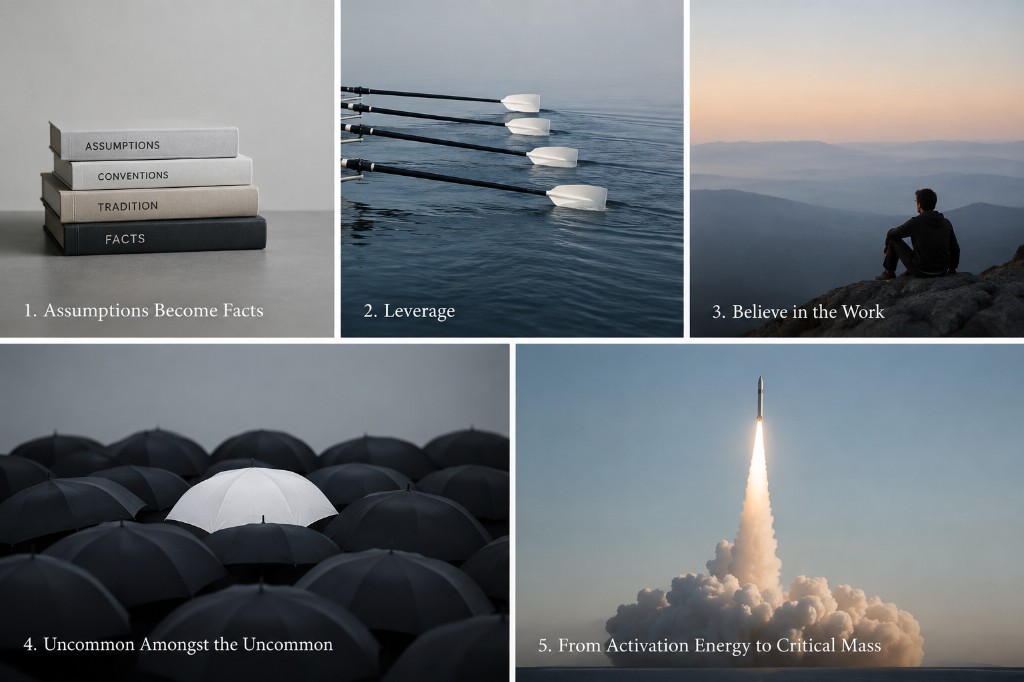
1. Assumptions Become Facts
As engineers, we make assumptions constantly. The problem is that assumptions, when repeated often enough and left unchallenged long enough, become facts.
The antidote is first-principles thinking: separate constraints from conventions and reason from what is actually true.
I really like the motto of the Royal Society, nullius in verba — take nobody’s word for it. Not because everything needs to be questioned for the sake of questioning, but because we should understand why something is true rather than simply inherit the belief that it is.
When I onboard to a new system, I try to question everything:
- Why can’t we do this?
- What would actually break if we did?
- Is this still true, or was it true five years ago?
There are two outcomes: if the assumption is valid, I understand the system better; if it’s invalid, I’ve challenged the status quo.
Time gives assumptions an undeserved sense of truth. Nullius in verba.
2. Leverage
As a junior engineer, I was conditioned to do everything myself. I expected myself to be good at every skill needed to get the job done. That starts to break as you become more senior.
I’ve learned to identify what I truly enjoy and become exceptional at it, while being honest about where I’m not great. I can delegate those areas while continuing to improve them over time.
The goal is to build on my strengths and leverage the strengths of people around me. The sum should be greater than its parts. That’s the joy of bringing people together.
3. Believe in the Work
I once looked out of my office window and saw a facilities worker intently cleaning the curb with a brush. It seemed like an incredibly tedious job, and I remember thinking, this person is spending their life doing something that barely matters.
I went back to my own routine: meetings, SQL queries, coding, resource planning, OKRs. Then it hit me — if my VP watched me doing all of this, it would be very easy for him to feel exactly the same way about my work.
And then I thought: what should anyone work on, then?
I realized that there is no objective hierarchy of important work. I think the most important ingredient in enjoying your job is believing that the problem you’re solving actually matters — that the thing you’re building genuinely needs to exist.
If I stop believing that, then the only answer is to leave. Don’t waste your life building something you don’t believe in.
4. Uncommon Amongst the Uncommon
One idea from David Goggins’ Can’t Hurt Me that has stayed with me is “uncommon amongst the uncommon.” He talks about how becoming a Navy SEAL made him ordinary again; he had entered a pool where everyone was already exceptional.
I think a similar pattern plays out for many of us:
Stage 1 — Common amongst the common. We start in a neighbourhood school, surrounded by students with broadly similar backgrounds. We’re one among many.
Stage 2 — Uncommon amongst the common. We start doing exceptionally well academically — topping our class, getting great grades, winning competitions. We stand out in our pool.
Stage 3 — Common amongst the uncommon. We get into a great college — an IIT, NIT, or another highly competitive institution — and suddenly we’re surrounded by people who were all exceptional in their previous pools. We lose the identity of being “the exceptional one” and become ordinary again.
Stage 4 — Uncommon amongst the uncommon. We work hard, graduate, and land an exceptional job — say at a FAANG company. Once again, we feel special. We’ve moved from being one among many exceptional people to standing out among them.
And then we start the job.
Suddenly, we’re back at Stage 3. Everyone around us is smart, accomplished, and capable. We’re common amongst the uncommon again. But we’ve seen this movie before. We know how to go from Stage 3 to Stage 4: work harder, get promoted, take on bigger roles.
Except this time, the path isn’t nearly as deterministic. Career progression depends on timing, opportunities, organizational needs, visibility, and a fair amount of luck. You can work hard for years and still not follow the trajectory you imagined.
Then something even stranger happens. After spending enough time at the same company, the thing that once made us feel exceptional becomes our new normal. The company, the compensation, the smart colleagues, the projects — all of it becomes familiar.
And now there is no longer anything around us that makes us feel uncommon. We are surrounded by people just like us, doing things that have become routine for us.
This is why it can feel like we’ve gone all the way back to Stage 1: common amongst the common. Not because we’ve become less accomplished, but because the environment that once made us feel exceptional has itself become ordinary.
I think this explains a part of the void that many high-achieving people eventually feel. The problem isn’t necessarily that our lives got worse. Our reference point changed.
The antidote, for me, is two things: first, define what uncommon means for you in the pool you’re currently in, rather than blindly chasing the next title or milestone. Second, maintain gratitude for the pool itself. What feels ordinary to you today may have been an extraordinary achievement a few years ago.
5. From Activation Energy to Critical Mass
I’ve started to think about innovation like launching a rocket into space.
The hardest part isn’t keeping the rocket in orbit. It’s getting it off the ground. You need to put in a disproportionate amount of energy upfront to overcome the initial resistance and reach the point where it can sustain its trajectory.
I think innovation works the same way. Every new idea needs to reach a critical mass. In the beginning, that requires disproportionate energy: questioning assumptions, making decisions with incomplete information, pulling people together, solving problems that don’t have obvious answers, and pushing through when there is little evidence that the idea will work.
But once you reach critical mass, something changes. The idea starts generating its own momentum. The team understands the problem, the technology matures, adoption starts to happen, and the amount of energy required to keep it moving drops significantly. That’s when I can move on to the next thing that needs that initial push.
The goal isn’t to keep pushing the same idea forever. It’s to push it hard enough to reach critical mass, then step back and let it compound.